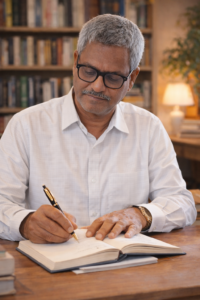
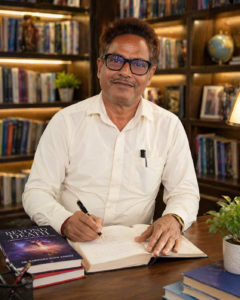
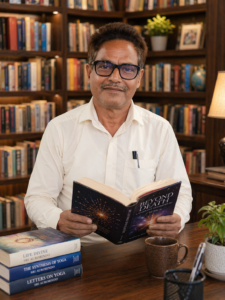
Author’s biography
Born on 15th August 1957 in a small village of Chhotadudpur, Bhograi Tehsil, Balasore district of Odisha, Dr. Rabindra Nath Sahoo grew up in a land that is culturally rich, educationally vibrant, and spiritually profound. Bhograi, the extreme end block of Balasore district in Odisha, is bordered by West Bengal in the east, the Bay of Bengal coast in the south, Baliapal tehsil in the west, and Jaleswar tehsil and town in the north. Here were born many luminaries, who have excelled in diverse walks of life, earning both national and international repute. Chhotadudpur being a satellite village under Bhograi Tehsil remained unseen and uncelebrated for long.
The village is graced by its nearness to the birthplace of Late Padma Shri Dr. Manoj Das, the acclaimed writer-philosopher, and closeness to sacred Chandaneswar Shiva Temple where countless devotees seek Lord Shiva’s grace. Dr. Rabindra, the second son among four, was born to his father Late Gajendra Nath Sahoo and mother Late Allahadi Sahoo in a family shaped by the challenges of feudal heritage and trials of poverty.
His father, though got teachership during pre-Independent India, could not keep up the job for his ailing father. The family was pushed to poverty due to failing crops with minimum cultivable land. Nurtured in such an environment, he flourished with a deep sense of curiosity, reflection, and commitment that later shaped both his professional journey as a doctor and spiritual growth, ultimately leading him to his profound quest into life’s meaning.
As far as he can recall, childhood was a time of distress marked by want and recurring illness. Around the age of ten or eleven he was gently persuaded to step onto stage as a lead performer of a newly formed village dance-drama. Poverty left no room for choice and the word of the village head carried weight he could not ignore. Yet, in that humble act, a silent door opened—guided not by ambition, but by the unseen hand of grace—offering both recognition and sustenance to once-forgotten hunger and village too found pride in his name. The medals and coins he received were never wasted—they became books and notebooks—the simple gifts that kept the flame of learning alive in his hands.
Time waits in the shadows until the inevitable walks into the light.
After school hours, his everyday activity was to move to other village (mode of communication by walking even if far away) along with the troupe to sing and dance whole night as a sacred duty to commit. Coming back in the next day morning even if tired of nightlong performance, he used to attend the class regularly as if dragged by an unseen force. Very impactful bitter day experience still glows on the slate of memory—when the drowsiness betrayed him in the mathematic class, and the sting of the shame became the lifelong reminder. He was humiliated before the class which was beyond one’s imagination and cannot be expressed by words. After that incidence, of course the concerned teacher was sacked by committee but he took oath to concentrate on study. He left the acting spree in spite of tremendous pressure. Though he stood adorned with applause and world of music and art beckoned with its seductive grace, he did not yield to its charms. Encouragement and honour may elevate a man but they do not define his path. He chose instead the path of quiet discipline over the allure of fame. His
Performance was so lively that it left a deep imprint in the society for years to come. It so happened that even after a decade, he was invited to act in an Odiya film by a producer. He of course acted in the film in a short role. He gently turned down the request from the CINE PHOTOGRAPHER of the film to move to Mumbai who recognised his talent in acting and invited to Bollywood industry. Though he stepped into the film world, compelled by earlier instinct he consciously turned away from its embrace – choosing not to pursue the industry further lest the allure of fame draw his family into life of economic uncertainty and fragile dreams.
After his departure, the dream that once stirred in the hearts of villagers quietly collapsed. With no one to fill his place hope and vision began to fade—not lack of will but for want of a worthy substitute. In the year 1970 during the class 7 board examinations, he secured the fourth position among his peers – a quite testament to his early promise and disciplined mind. In spite of shattering poverty, he pressed on to the studies, holding fast to the fragile thread of hope. His parents were only stewards in that darkness bore the weight of survival with quiet strength. And though the path of learning called to him he often stepped into the fields and labour of daily life – helping his father in cultivation and other humble tasks not out of obligation but out of silent solidarity.
At last, fortune smiled upon him. In the final class 11 BSE Examination of Odisha held in the year 1974, he rose to the top – securing the first position among the hundreds of students. That singular triumph not only marked the culmination of the years of quiet perseverance, but also earned him a place among the distinguished hundred across the state who were awarded the coveted National Scholarship that year.Of course, a boon in disguise.
Four years past of that scarry 1970’s school trauma again he was burdened by troubles and haunted by trauma. Call it what you will—a trial of time, a divine test in the race of life or the karmic fruit ripened by fate—but it was the noose cast by his own elder brother that tightened around his neck, marking a moment not merely of pain but of cosmic reckoning. His brother was then working in Kalahandi, a remote district of Odisha. Before the publication of Board result, Dr Sahoo, by then went there for a vocational tour after completing board exam. The news of standing first in his class filled him with quiet exultation and in that moment of triumph his inner yearning for learning deepened.
His brother had a very different plan and the very result struck a blow to his brother’s vision which he had long harboured. Yet, despite his academic triumph and the promise it held, his brother insisted to abandon further study and take up a job—pressing him to earn for family to get rid of poverty. Pressed hard by his brother they both went to meet Mr Sharma, the designated authority for his recruitment to the post of phone operator. He vividly remembers how the phone inspector, Mr Sharma alerted his brother for the foolish act. Confused and angered by the unfolding of the situation his brother sent him back home with a short-sighted promise of entry into a reputed, DAV Autonomous college Titilagarh, Odisha.
When intimation letter for college admission failed to arrive home nor any information from brother reached a painful truth surfaced—he discovered that the application form he had carefully filled out had never been submitted and with it the door to academic had silently closed.
Returning home he was met with hardship and gnawing agony of uncertainty. Determined to pursue his academic dreams he moved from pillar to post seeking entry into government college—yet the doors remained shut. Then, as if moved by the silent tears of an innocent soul struggling against fate, providence intervened.
Sindhu Devi, the esteemed principal of Fakir Mohan College in Balasore—named after the legendary writer and first architect of Odiya literature and ranked among the finest institutions of Odisha—chose compassion over convention. She overruled the rigid admission procedure and granted him a late entry turning despair to destiny. (He had failed to submit the entry form in due time, though he had very high scores in board result.) In the ISC university examination of 1976, Dr. Sahoo passed with first division honours—a commendable achievement by any measure. Yet, despite his success he fell short of fulfilling the principal’s cherished dream: to see him among the top ten college pass-outs in the state. It was a moment where pride and disappointment quietly coexisted each casting its own shadow on the path ahead. In time, he came to recognize the mistake of overdependence—placing too much trust in a friend with whom he had shared the journey of study, and at the final moment the friend betrayed him.
In 1976, he entered the MBBS course by clearing the newly introduced entrance examination by govt of Odisha. Over the next five years he emerged not as a diligent student but as a multi-talented admired figure in the campus. Honest and helpful by nature he earned admiration from peers, seniors and juniors all alike. A skilled volleyball player, he captained his class team to championship victory only in his second year of study. He was a winner in pole-vault event in annual championship athletic meet in two successive years. Sometimes happiness is but a faint murmur echoing through forests and rivers present yet overlooked in the haste of life. Goutam Bhai, (a senior athletic friend as he used call him fondly) suggested to run his candidature for college sports secretary post which he humbly denied. His peers unanimously chose him class representative in his third year of study, not just for his leadership quality but for the trust he inspired.
with the background in dance drama in his early years he was pulled to the stage and captivated the audiences with his performance. As a poet his philosophical songs found its place in the college magazine reflecting his depth of thought and artistic spirit. A committed learner he completed the final university examination with first division in the year 1981 adding academic excellence to a vibrant legacy of talent and character.
At 24, in 1982, Dr. Rabindranath married a gentle, innocent girl from a wealthy family in Hatbadra—a village in Mayurbhanj district, Odisha, located near Uparbeda, the birth place of Honourable President of India, Droupadi Murmu. Her father, a devout Worshipper of Goddess Durga, claimed to possess supernatural powers—an assertion that echoed the sacred walls of grand temple he had built on his own residential land. The temple, still revered as family’s spiritual sanctuary, stood as a testament to his unwavering faith.
Whenever Dr. Sahoo visited his in-laws, he was subtly drawn into the aura of divine presence. His father-in-law, with quiet conviction, would hint at the mystical presence of Devi Maa, planting seeds of spiritual curiosity in young doctor’s heart, who was once tuned to modern life of materialism. It was those moments between rituals, the stories and silent power of belief—that Dr. Sahoo’s first step into spiritual realm began. Not through doctrine but through experience. Not through books (though book helped in his progressive journey) but through the living faith of a man who saw the divine not as distant but as dwelling within.
The first turning point in Dr. Sahoo’s philosophical journey came as if destined. Nearly thirty years ago, he led a family tour to South India—seven members in all: his wife Manju, two young kids Rinam and Pritam, his mother-in-law Jashoda Devi, his brother-in-law—Bhagban and his wife—Binu. Among the sacred stops was the revered Sri Aurobindo Ashram in Puducherry. Moved by the atmosphere, they spontaneously decided to visit Dr. Manoj Das, the celebrated writer-philosopher, who hailed from the same locality as Dr. Sahoo though the two had never met before.
Dr. Das welcomed them warmly and as they sat together for a formal tour experience, Dr. Sahoo felt compelled to ask a question that had long haunted him—a spark that was ignited by his father-in-law. The question was on different dimensions of life that has echoed through the corridors of human enquiry:
“Have you ever felt the divine power of Shrima—Sri Aurobindo?”
The question was bold, straight and almost unexpected from me. But, Dr. Das, serene and smiling, replied with quite wisdom:
“Have you ever tasted a pinch of sugar? How does it taste? Sugar is sugar—no one can explain it. But one can experience it.”
The journey ended with visit of other holy places in South India but the answer lingered. That moment planted a seed—a philosophy not of explanation but of experience. Echo that once stirred quietly within began to magnify in intensity—resonating louder with each passing years as if universe itself has chosen to amplify its inner calling.
The timeless truth—time and tide wait for none—unfolded in Dr. Sahoo’s life as a steady current carrying him towards trials yet to come. In 1983, he was officially posted to Jaleswarpur CHC as a Family welfare officer. Yet under political pressure he was abruptly deputed to new, Chandaneswar SHC in Chandaneswar—a remote underserved corner of Odisha where his true struggle began and, in many ways, still continues.
The region is impoverished in every material sense, yet rich in spiritual essence (Lord Shiva being the worshipped Deity)—the divinity of the land seemed to mingle with its very soil. As the lone qualified physician at the time, Dr sahoo bore the weight of daily hardship, social responsibility, and financial strain. The path of service was steep, and the burden layered—enough to choke any hope of escape. But he stayed not out of obligation but out of conviction and worked and worked. His only strength lay in his unwavering honesty and truthfulness.
Dr. Sahoo’s growing reputation—earned through his pivotal role in regularizing the Chandaneswar Sub-Health Centre from private control to Government oversight, and his election as President of Chandaneswar Mahavidyalaya, Sahabajipur (close to West Bengal Border)—did not sit well with certain politically aligned groups. Out of sheer jealousy, he was abruptly transferred to Manatri Govt Hospital in Mayurbhanj, a move widely regarded as a “punishment posting.”
The transfer was undesired, but not unfamiliar—struggle had become a recurring theme. At times he felt as though luck was mocking him. Manatri was remote, not suitable for schooling of the children, burdened and isolating. Yet for two years he endured, serving with determination. Due to illness of his wife, he remained on leave. Eventually he was transferred to another nearby SHC offering a brief glimmer of relief. But fate had other plans. Just three months into the new posting he made a difficult decision: to resign from govt service and devote himself fully to private practice.
The decision to resign from government service was not born of personal choice alone—it was result of persistent political meddling. The then health minister, who hails from same locality, was notably unsupportive of Dr. Sahoo’s posting and under her influence environment grew increasingly hostile. With dignity intact but spirit worn thin he chose to step away—not in defeat but in protest against a system that no longer allowed him to serve freely.
Over the course of ten years and eleven months, Dr. Sahoo firmly established himself as one of the finest physicians in the region—respected by the good and sought after by the suffering. He founded a Nursing home in his residence in ground floor where the earning and serving ran in parallel, each reinforcing the other.
As his reputation soared, old adversaries—once silenced by his rise—reawakened, driven by political and personal envy. Their hostility escalated from mental harassment to threats of physical harm. It became increasingly clear that the organised threat he faced was not merely a social or personal conflict—it bore a signature of darker force. Orchestrated by the wealthy man of the locality (the king-pin of gang of five), the act carried the weight of malice and manipulation echoing what mystics often describe as the workings of devil’s hand. In spiritual traditions such targeted attacks are seen not just as human cruelty but manifestation of deeper, unseen battles between light and shadow.
In the midst of this storm, a divine intervention arrived in human form. Mr. Paresh Chandra Nayak, then Secretary to Chief Minister Shri Naveen Patnaik, suggested that Dr. Sahoo consider rejoining government service for second time. At that critical crossroads torn between uncertainty and conviction, he surrendered the decision to God. Perhaps it was the divine will—or the culmination of an unseen test of faith. But Mr Nayak stood by his side like an unmoving rock—an embodiment of selfless service and love.
He re-entered the service with renewed purpose in 2003, after a gap of 10 years and eleven months. His inner calling was unmistakable—quiet but resolute. It was not ambition, nor persuasion but a deeper voice within that guided him towards the decision. He holds an unwavering conviction that it was the whisper of God within—a quiet sacred guidance—that gently steered him through the storm.
Of distress ,over the years (again sixteen years) earned three more promotions ultimately retiring from the post of Additional Director of Health Services Odisha on 31st August 2019.
Following his retirement, Dr. Sahoo was invited to rejoin government service in post-retirement capacity by a highly placed administrative officer who held him in great esteem. Yet with humility and clarity he declined—choosing instead a quieter path of reflection and inner growth. Today, he finds joy and fulfilment in immersing himself in a wide spectrum of literature—from philosophy and spiritualism to autobiographies and teachings of mystics and seers.
His reading list is a sacred tapestry woven with the wisdom of BHAGVAT GITA, Manduka Upanishad, Mahavata Babaji, Lahiri Mahasaya, Swami M. Ram, Paramahansa Yogananda (Autobiography of a Yogi, 1946), Swami Vivekananda, Ramkrishna Paramahansa, Bhagavan Ramana Maharshi, Radhanath Swami, Jiddu Krishnamurti, Srila Prabhu pada, Eckhart Tolle (Author of famous book, The Power of Now, 1997), Shri M. Sadguru’s Inner Engineering and many more. Each page offers not just knowledge but a deep resonance with eternal truths that guided his life.
Spiritually his path has stretched from sacred heights of Badrinath to the southern tip of Kanyakumari—a pilgrimage across India’s spiritual spine. The only exception are Dwarka, the ancient kingdom of Lord Krishna in Gujarat and Kamakhya temple at Hilltop of Guwahati, Assam which he still hopes to visit someday.
Alongside his deep study of philosophy and spiritual literature, Dr. Sahoo continues to serve patients with unwavering sincerity in his own clinic. His commitment to healing and lending support to the sufferings remain as steady as ever—rooted in compassion and discipline.
He also finds joy in travel, often journeying to United Kingdom, where he has explored nearly all major historical and modern tourist destinations across England, Scotland, Wales, Northern Ireland. In his travel, Dr. Sahoo found joy not only in the breathtaking landscapes—the silent majesty of mountains, the whispering forests, the rhythmic embrace of the pristine beaches—but also the silent contemplation they inspired.
Each journey became more than destination. As he wandered through mountain valleys blanketed with grazing sheep, a childhood memory stirred gently within him—the simple rhyme of Baa Baa Black Sheep… What once was a playful tune now echoed with deeper meaning. It reminds him that life in all its vastness, remains beautifully simple, quietly innocent, and deeply in tune with nature.
Standing at the edge of Wales, where the land surrenders to sea, Dr. Sahoo gazed out from the extreme coastal end point—his eyes stretching towards the far north pole, where man have reached to explore the nature and geopolitical ambition, an enduring act of quest to conquer the unknown. The horizon felt infinite, the air crisp with silence. In that moment the vastness of nature whispered to the soul, reminding him how small we are, and yet how deeply connected to the cosmos.
Beyond nature’s grandeur, Dr. Sahoo also immersed himself in the marvels of human creativity. At Madame Tussauds, he witnessed the life like artistry that captures the fame and memory making alive; at British Museum, he walked through centuries of civilization, feeling the pulse of history in every artifact; and at the tower of London, he witnessed the power, intrigue, and resilience etched into its stone walls. In these man-made wonders, he observed how life flows—not just through people, but through legacy, imagination, and the silent stories that endure.
Amidst the beauty, he explored what life meant to others and more profoundly what it meant to himself. Enjoyment and inquiry walked hand in hand, as nature became both a sanctuary and a teacher.
Dr. Sahoo’s life story began in solemn depth, yet it unfolds towards a conclusion shaped by divine justice and metaphysical truths that defy human reasoning. In the realm of mysticism and spiritual philosophy, there exists a profound teaching: never ever harm the innocent, for God resides in their purity. This principle resonates across traditions—from philosophies to Upanishadic reverence for the Atman in all beings, to Christian call to “become like little children” to enter the kingdom of heaven. Now even reflected in modern legal system because from ancient scriptures to modern constitution there is a shared belief that harming the innocent is a grave moral wrong.
Mystics and Enlightened beings have long taught that the acts of cruelty—especially toward the pure hearted—do not vanish into silence. Instead, as divine law of moral balance, such actions rebound upon the perpetrator, often with grave consequence. The core idea is often called the Law of Divine Reciprocity or Specific application of Karma: that harming innocent creates a severe karmic debt that must be balanced, often in this life.
Throughout history, the lives of sages, saint, mystics—from Ramkrishna Paramahamsa to Bhagavan Ramana Maharshi to Saint Francis of Assisi—have illustrated this truth. Those who harmed them often faced spiritual or existential crisis and consequences while those who honoured their innocence were uplifted. Many contemporary teachers frame it in terms of energy. An innocent being, especially a child or saintly person has a pure high vibrational energy field. To violently attack that purity creates a severe energetic dissonance. The perpetrator’s own energy field its form and depth in some chapters. The preface, introduction, biographical notes have been carefully fine-tuned for greater clarity, smoother flow and expanded vision.
Let these pages be quite mirror-reflecting not just words but the stirrings of your own thought.
Rabindranath Sahoo.